Condition
Pain and swelling on the outside of the ankle after rolling it.
We’re closed right now. WhatsApp us and we’ll reply when we open.

- Registered Chiropractor 註冊脊醫
- Doctor of Chiropractic D’Youville College, USA
- Whampoa & Hung Hom Near Whampoa MTR
An ankle sprain is an injury to the ligaments that hold the ankle bones together, usually from rolling the foot inwards on uneven ground, a kerb or a step, or when landing from a jump. Most sprains affect the ligaments on the outside of the ankle and get better with the right early care and a gradual return to activity, but up to a third of people still have some pain a year later, often because rehabilitation stopped too soon. If you can’t put weight on the foot, or the bone itself is tender, have it checked for a fracture first.
Key points
- The classic pattern is rolling the foot inwards, followed by pain, swelling and bruising on the outside of the ankle.
- If you can’t take four steps, or the bony edge of the ankle or foot is tender, see a doctor to rule out a fracture.
- In the first few days, protect the ankle, use ice, compression and elevation, and keep it moving gently within comfort rather than resting it completely.
- Balance and strengthening exercises are the most reliable way to reduce the chance of spraining it again.
The ankle is held together by strong bands of tissue called ligaments. On the outside of the ankle, three ligaments connect the lower end of the fibula, the bony bump on the outside of the ankle, to the bones of the foot. The one at the front, the anterior talofibular ligament, is the weakest and the one most often injured; in a more severe sprain, the calcaneofibular ligament below it is torn as well.
Sprains are graded by how badly the ligament is damaged: overstretched (grade 1), partly torn (grade 2) or completely torn (grade 3). Less often, the ligaments on the inside of the ankle, or the ligament joining the two leg bones just above the ankle (a “high ankle sprain”), are injured; these usually take longer to heal.
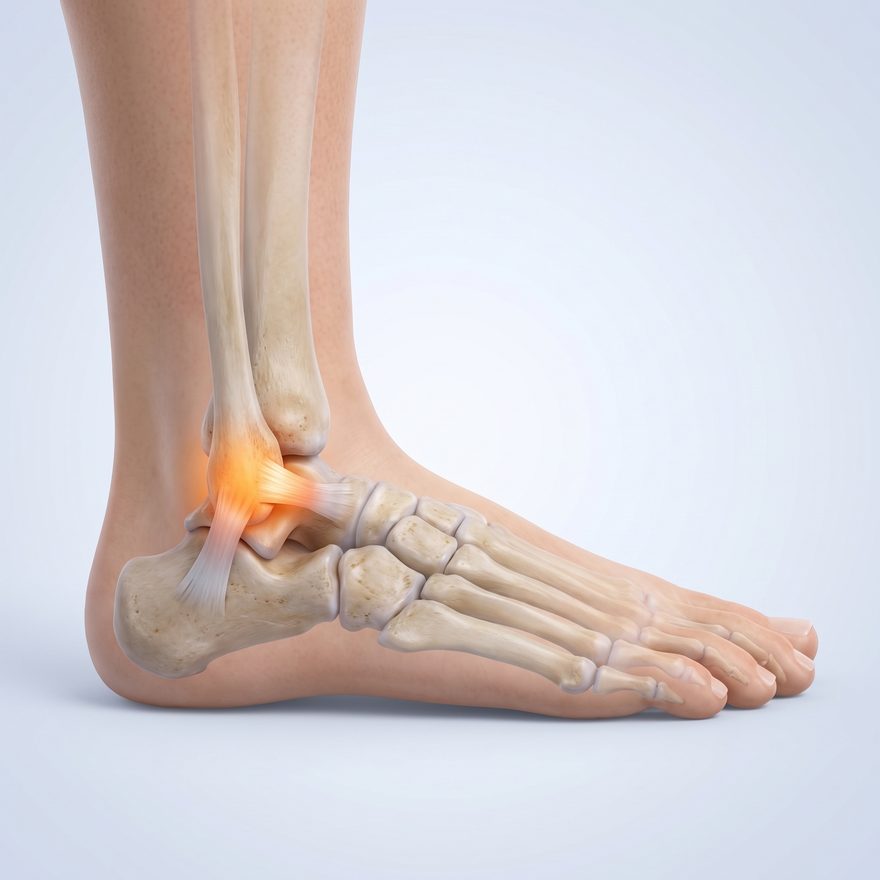
Symptoms usually start straight away, and some people feel or hear a pop at the moment of injury.
Common symptoms
- Pain on the outside of the ankle, worse when you stand or walk
- Swelling around the ankle, often within a few hours
- Bruising, which may spread down to the side of the foot and the toes over the next few days
- Tenderness when you press just in front of or below the bony bump on the outside of the ankle
- Stiffness, and an ankle that feels unstable or gives way
How it recovers
Most sprains heal in these stages:
- First daysPain and swelling are at their worst and walking is painful. The ankle is best protected and kept raised.
- Weeks 1 to 3Swelling settles and walking becomes easier. Gentle movement and early balance work help the ligament heal.
- Weeks 3 to 12Strength and balance are rebuilt, and most people return to sport, though the ligament keeps strengthening for months.
A mild sprain may settle within two weeks; a severe one can take three months or more. Returning to sport too early is a common reason the ankle is sprained again.
Most ankle sprains happen when the foot rolls inwards and the ankle twists outwards, stretching the ligaments on its outer side.
- Stepping awkwardly on uneven ground, a kerb, a stair edge or someone else’s foot
- Landing from a jump or changing direction quickly, in sports such as basketball, football, badminton and volleyball
- Running or hiking on uneven trails
- Wearing high heels, or shoes that give the ankle little support
- A previous ankle sprain, especially one that didn’t fully recover
- Poor balance or weak muscles around the ankle
A previous sprain is the biggest single risk factor for spraining the same ankle again.
These checks are based on the rules doctors use to decide whether an X-ray is needed. They can point to a possible fracture, but they can’t rule one out.
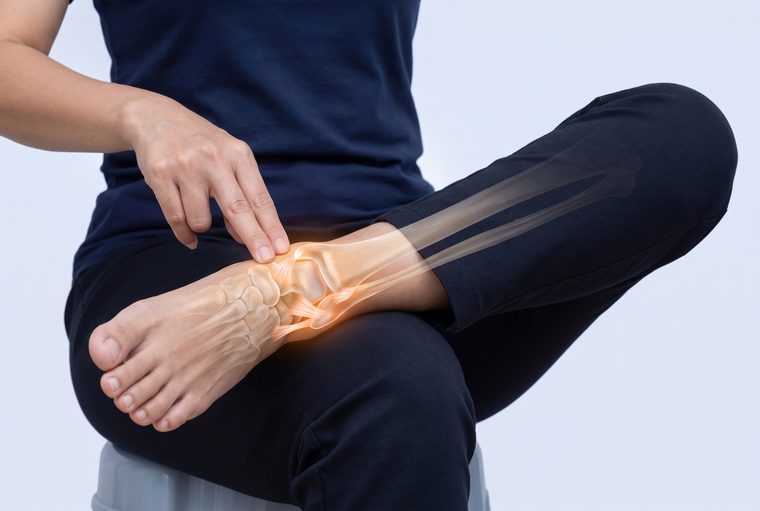
Bone tenderness check
Sitting down, gently press along the back edge and the tip of the bony bump on the outside of the ankle, then do the same on the inside. Also press on the bony bump halfway along the outer edge of the foot. Pain when you press directly on the bone, rather than on the soft tissue in front of it, is a warning sign.

Four-step check
Try to stand on the injured foot and take four steps, even if you limp. If you can’t take four steps, either straight after the injury or when you are checked later, you should have an X-ray.
If either check is positive, see a doctor or go to an accident and emergency department. Even if both are negative, have the ankle assessed if the pain is severe or isn’t improving after a few days.
Other injuries can feel like a sprain at first. Telling them apart matters, because some need different treatment.
Ankle sprain (the ligaments on the outer ankle)
- Where it usually hurts
- Just in front of and below the bony bump on the outside of the ankle
- Other clues
- Swelling and bruising; you can usually take a few steps
Ankle or foot fracture
- Where it usually hurts
- Directly over a bone, often the back or tip of an ankle bone, or the outer edge of the foot
- Other clues
- Bone tenderness, being unable to take four steps, or an ankle that looks out of shape
High ankle sprain
- Where it usually hurts
- Higher up, at the front of the ankle between the two leg bones
- Other clues
- Pain when the foot is turned outwards; usually takes longer to recover
Achilles tendon injury
- Where it usually hurts
- The back of the ankle, above the heel
- Other clues
- A sudden pop or the feeling of being kicked; difficulty pushing off or rising onto tiptoe
A sprain can also damage the cartilage inside the ankle joint or the tendons behind the outer ankle bone. If pain, swelling or giving way continues beyond about six weeks, it is worth having the ankle re-assessed.
Further reading: Knee pain, Plantar fasciitis.
A sprain is diagnosed mainly from how the injury happened and a physical examination.
Your history: How you injured the ankle, whether you could walk afterwards, and any previous sprains.
Physical examination: Checking where it is tender, how the ankle moves, how stable the ligaments are, and your balance. Stability tests are often more accurate a few days after the injury, once the swelling has settled.
Further tests: An X-ray if a fracture is possible. If symptoms persist or a more serious injury is suspected, Dr. Ho may suggest an ultrasound or MRI scan, or refer you to an orthopaedic doctor.
Most ankle sprains, including many complete ligament tears, recover well without surgery. Treatment aims to settle the pain and swelling first, then restore movement, strength and balance.
Non-surgical treatment
- Early care (the first few days): Protecting the ankle, ice for 15 to 20 minutes at a time, a compression bandage, and keeping the foot raised. Crutches can help if walking is very painful. Avoid heat, alcohol and vigorous massage in the first two to three days.
- Gentle movement and early walking: Moving the ankle within comfort, and putting weight on it as soon as you can, usually leads to a faster recovery than keeping it completely still.
- Brace or taping: A lace-up or semi-rigid brace, or taping, can support the ankle in the early weeks and when you return to sport. Braces are generally available from pharmacies or sports shops.
- Progressive rehabilitation exercises: Movement, strengthening and balance exercises, progressing to hopping, running and sport-specific drills. Exercise is the best-supported way to reduce the risk of the ankle giving way again.
- Hands-on treatment: Mobilising the ankle and foot joints and easing tight surrounding tissues may help restore movement and ease pain in the short term.
Treatment prescribed by a doctor
- Medication or a walking boot: Painkillers or anti-inflammatory medication may ease pain in the short term. A short period in a walking boot or cast may be used for severe sprains.
Surgery
- Ligament repair or reconstruction: Generally considered only when the ankle keeps giving way despite a full rehabilitation programme, or when there is an associated fracture or joint damage.

Dr. Ho first checks whether a fracture or another injury needs to be ruled out, then plans treatment based on the findings. General information only — your plan is set after an in-person assessment.
- 01
Assess
Checking the ankle and foot ligaments, movement, swelling and balance, and whether you need an X-ray before treatment.
- 02
Treat
Hands-on treatment to restore ankle and foot movement, soft tissue care for the surrounding muscles, and advice on bracing or taping where needed.
- 03
Rebuild
A progressive programme of strength, balance and agility exercises, building up to your work, daily activities or sport.
- 04
Refer
If a fracture, a complete tear with ongoing instability, or joint damage is suspected, you will be referred for imaging or to an orthopaedic doctor.
Once you have sprained an ankle, keeping up balance and strength exercises is the best way to stop it happening again.
- Practise standing on one leg for 30 seconds at a time, progressing to doing it with your eyes closed or on a cushion.
- Strengthen the muscles around the ankle with heel raises and resistance-band exercises.
- Warm up before sport, and build training back up gradually after an injury.
- Wear supportive shoes suited to your sport, and replace worn-out trainers.
- Consider a brace or taping for sport for up to a year after a sprain, especially if the ankle has given way before.
- Take care on wet or uneven ground, stairs and kerbs, and avoid high heels while the ankle is recovering.

When to seek medical attention promptly
Seek medical attention promptly if any of the following apply:
- Being unable to put weight on the foot or take four steps
- Pain when you press directly on the ankle bones or the outer edge of the foot
- An ankle or foot that looks deformed or out of place
- Numbness or tingling, or a foot that is cold or pale
- A pop at the back of the ankle, with difficulty pushing off or standing on tiptoe
- Swelling, redness and warmth that keep getting worse, especially with a fever
A mild sprain may settle within one to two weeks, a moderate one in three to six weeks, and a severe one can take three months or more. The ligament keeps strengthening for months after the pain has gone, so finishing your rehabilitation matters.
In the first two to three days, ice wrapped in a cloth, for 15 to 20 minutes at a time, can help ease the pain. Avoid heat, alcohol and vigorous massage during this time, as they may increase swelling.
Not always. An X-ray is usually needed if you can’t take four steps, or if the bony edges of the ankle or the outer edge of the foot are tender. If you’re unsure, have it checked.
Protect the ankle for the first few days, but avoid resting it completely for long. Gentle movement, and walking as soon as comfort allows, usually leads to a faster recovery.
After a sprain, the ligament may heal slightly looser, and the ankle’s balance and sense of position can be reduced. Without balance and strengthening exercises, the ankle may keep rolling. This is called chronic ankle instability, and it usually improves with a structured exercise programme.
That depends on your policy terms. Cover for outpatient care, imaging, surgery and chiropractic treatment varies between policies, so check with your insurer before your visit. We are happy to provide receipts to support your claim.
Disclaimer
This page is general information only, not a diagnosis or treatment advice. If you have any symptoms, please consult a qualified healthcare professional.
Further reading
These public health pages cover the same condition in more depth.
- NHS: Sprains and strains

Book a consultation with Dr. Ho, or message us on WhatsApp with any questions first.