Condition
A finger or thumb that clicks, catches or locks when you bend it.
We’re closed right now. WhatsApp us and we’ll reply when we open.
- Registered Chiropractor 註冊脊醫
- Doctor of Chiropractic D’Youville College, USA
- Whampoa & Hung Hom Near Whampoa MTR
Trigger finger (stenosing tenosynovitis) happens when a tendon that bends a finger or thumb can no longer glide smoothly through its tunnel at the base of the finger. The finger may click, catch or lock in a bent position, then straighten with a painful snap. It most often affects the ring finger and the thumb, and is more common in women, people over 40 and people with diabetes. Mild cases often improve with less forceful gripping, a splint and exercises; if a finger is locked and won’t straighten at all, or is hot and swollen, have it seen promptly.
Key points
- The classic signs are a tender lump at the base of the finger on the palm side, and a finger that clicks or catches as you bend and straighten it.
- It is often worse first thing in the morning and eases as the hand warms up during the day.
- Treatment depends on severity: from easing how hard you grip, a splint and exercises, to a steroid injection or a minor operation.
- A finger stuck bent that you can’t straighten, or a hot, red, swollen finger, needs prompt medical attention.
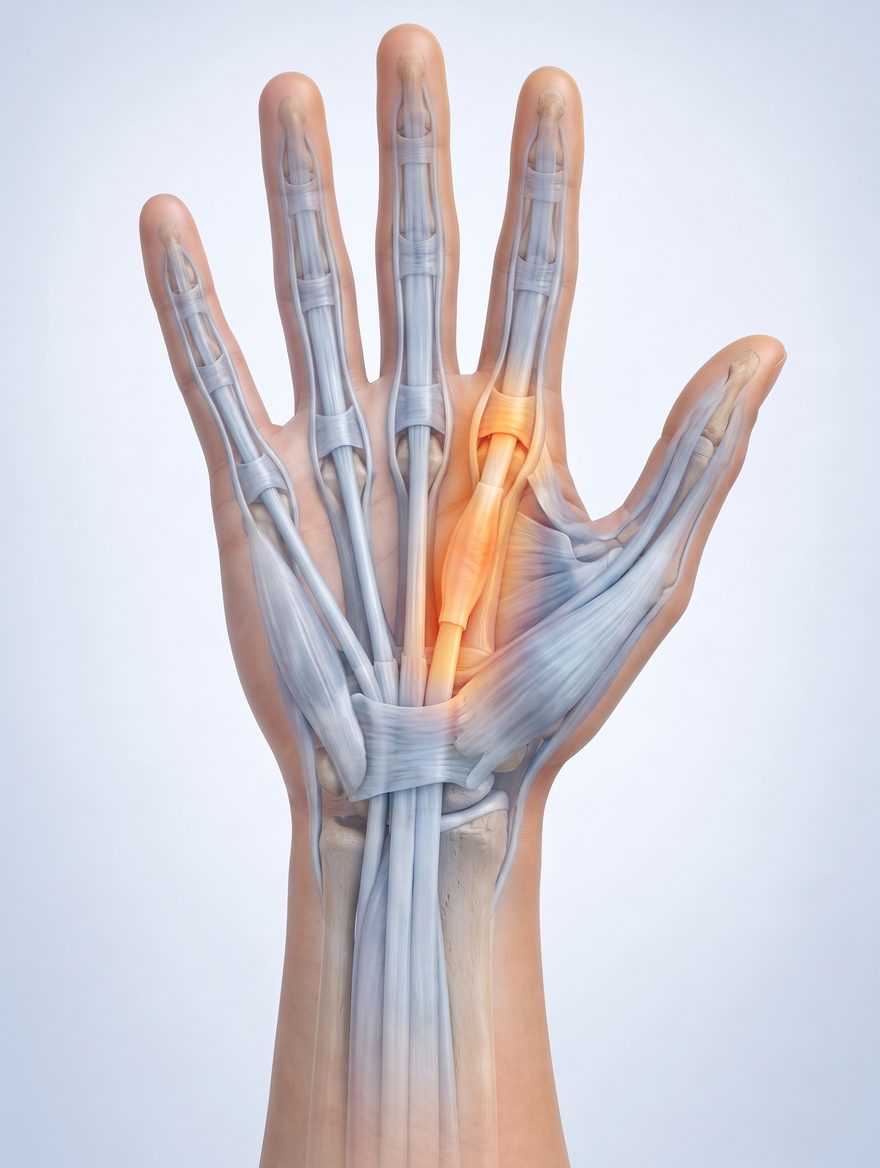
The tendons that bend the fingers run from the forearm, through the palm and along the front of each finger. Tough bands called pulleys hold them close to the bones, and each tendon slides inside a lubricated sheath. The first pulley, the A1 pulley, sits at the base of the finger, under the crease where the finger meets the palm.
In trigger finger, the A1 pulley and the tendon sheath thicken and narrow, and a small nodule can form on the tendon. The tendon then catches as it passes under the pulley, which causes the clicking, and in some cases the finger locks until it is pulled straight. Each catch can irritate the tissues further, so the problem tends to continue unless the load on the finger is reduced.
Symptoms usually come on gradually, and more than one finger can be affected.
Common symptoms
- A tender lump at the base of the finger or thumb, on the palm side
- Clicking, catching or popping when you bend or straighten the finger
- The finger locking in a bent position, then snapping straight, sometimes painfully
- Stiffness, especially first thing in the morning
- In more severe cases, a finger that stays bent until you straighten it with the other hand, or that no longer bends fully
How it progresses
It usually progresses in these stages:
- EarlyPain and tenderness at the base of the finger, with some stiffness but no clicking yet.
- MiddleThe finger clicks or catches when you bend and straighten it, but still straightens on its own.
- LateThe finger locks and has to be straightened with the other hand, or can no longer fully bend or straighten.
Symptoms can come and go. Mild cases sometimes settle on their own, but a finger that keeps locking usually needs treatment.
The exact cause isn’t always clear, but repeated or prolonged gripping and some health conditions make it more likely.
- Repeated or forceful gripping, such as using hand tools, garden shears or kitchen knives
- Carrying shopping bags with the handles hooked over the fingers
- Long periods holding a phone, a steering wheel or a handle
- Diabetes, which makes trigger finger several times more likely
- Rheumatoid arthritis, gout and an underactive thyroid
- Being a woman aged 40 to 60, and having carpal tunnel syndrome
Trigger finger affects around 2 to 3 in 100 people at some point, and up to 1 in 5 people with diabetes.
These two simple checks can give a first indication, but they cannot confirm a diagnosis. Stop if either causes sharp pain.
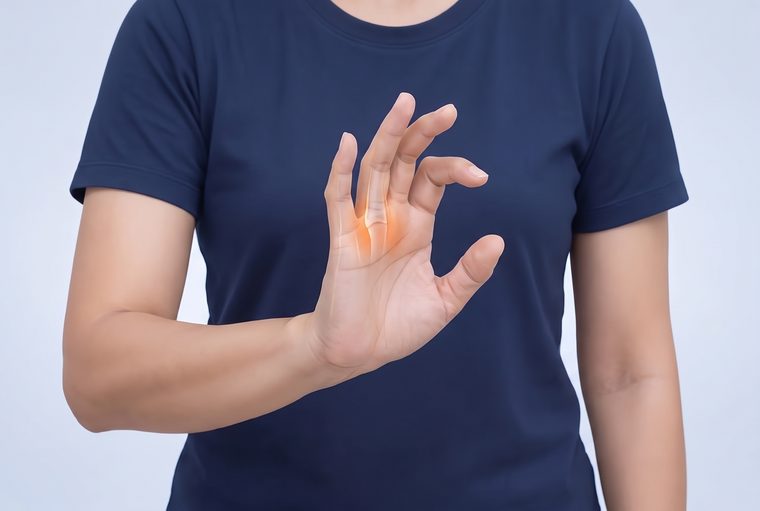
Fist-and-open check
Slowly make a full fist, then slowly open your hand and straighten all your fingers. A finger that catches, clicks, or lags behind and then snaps straight is a positive result.
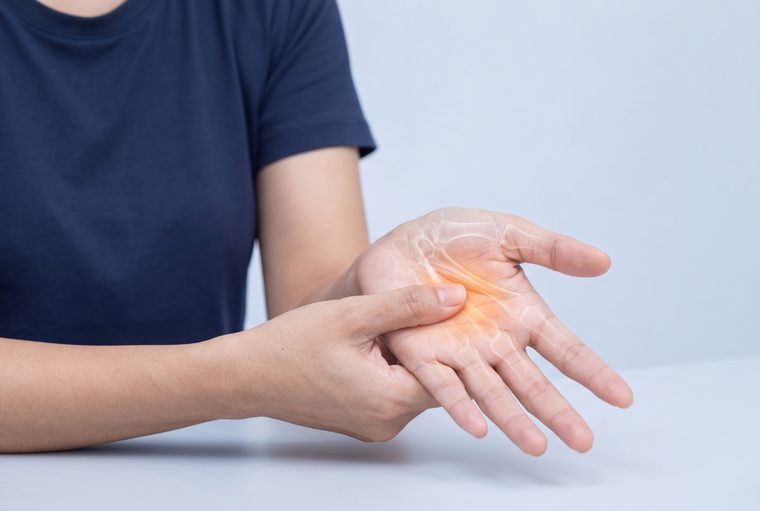
Pressure check
With your palm facing up, press your other thumb into the palm at the base of the affected finger, then slowly bend and straighten the finger. A tender lump that you can feel moving or clicking under your thumb is a positive result.
A positive result doesn’t confirm trigger finger, and a negative one doesn’t rule it out. If a finger locks, or the problem keeps coming back, have it assessed by a healthcare professional.
Several conditions can cause a stiff, painful or bent finger. Finding the cause is the key to choosing the right treatment.
Trigger finger (the tendon catching at the base of the finger)
- Where it usually hurts
- The palm, at the base of the finger or thumb
- Other clues
- Clicking, catching or locking; a tender lump that moves as the finger bends
Dupuytren’s contracture
- Where it usually hurts
- Cords and lumps in the palm, usually towards the ring and little fingers
- Other clues
- The finger is slowly pulled bent and can’t be straightened, but it usually doesn’t hurt or click
Arthritis of the finger joints
- Where it usually hurts
- The finger joints themselves
- Other clues
- Swollen, stiff knuckles; pain when the joint moves, without catching
Carpal tunnel syndrome
- Where it usually hurts
- Numbness in the thumb, index and middle fingers rather than pain at one spot
- Other clues
- Numbness or tingling, often at night; often occurs together with trigger finger
Trigger finger and carpal tunnel syndrome are often found together, so Dr. Ho checks the whole hand and wrist, and the neck if there is numbness.
Further reading: Carpal tunnel syndrome, De Quervain’s tenosynovitis.
Diagnosis is usually made from your symptoms and an examination of the hand. Scans are rarely needed.
Your history: Which fingers are affected, when it is worst, your hand-use habits, and conditions such as diabetes or arthritis.
Physical examination: Feeling for a tender nodule at the base of the finger, watching for catching as you bend and straighten it, and checking the finger joints and the rest of the hand.
Further tests: If the diagnosis is unclear, Dr. Ho may suggest an ultrasound scan, refer you for a nerve conduction study if numbness suggests a nerve is involved, or refer you to an orthopaedic or hand surgeon.
Mild cases often improve without injections or surgery. Treatment aims to settle the irritation at the pulley so the tendon can glide smoothly again.
Non-surgical treatment
- Reducing the load on the finger: Avoiding forceful or repeated gripping for a while, using tools with thicker handles, and taking regular breaks.
- Splint: A small splint that holds the affected finger straight, usually worn at night for several weeks, may ease symptoms, especially in milder cases. Finger splints are generally available from pharmacies or hand therapists.
- Tendon-gliding and stretching exercises: Gentle exercises that move the tendons through their full range may help ease stiffness.
- Soft tissue treatment: Easing tight tissues in the palm and forearm may help with pain and stiffness in the short term.
- Shockwave therapy: Some studies suggest shockwave therapy may help reduce pain and catching in some cases, although the evidence is still limited.
Treatment prescribed by a doctor
- Steroid injection: An injection into the tendon sheath often eases symptoms, and is commonly used when the finger catches or locks. Symptoms can come back, and the effect tends to be smaller in people with diabetes.
Surgery
- Trigger finger release: A short procedure, usually under local anaesthetic, that releases the A1 pulley so the tendon can glide freely, either through a small cut or with a needle. It is generally considered when other treatment hasn’t helped or the finger stays locked.

Dr. Ho first finds what is causing your finger symptoms, then plans treatment based on the findings. General information only — your plan is set after an in-person assessment.
- 01
Assess
Examining the fingers, palm, wrist and forearm, and checking for related problems such as carpal tunnel syndrome or numbness coming from the neck.
- 02
Treat
Soft tissue treatment for the palm and forearm, combined with shockwave therapy where suitable, and advice on whether a splint may help.
- 03
Exercise and habits
Tendon-gliding exercises, and practical changes to how you grip and carry things at work and at home.
- 04
Refer
If the finger locks, doesn’t improve, or an injection or surgery may need to be considered, you will be referred to a doctor or hand surgeon.
Easing how hard and how long you grip can help reduce the load on the finger tendons.
- Carry shopping bags over your forearm or use a trolley, rather than hooking the handles over your fingers.
- Use tools and kitchen utensils with thicker, cushioned handles, and don’t grip harder than you need to.
- Take regular breaks from repetitive tasks such as gardening, cutting or using hand tools.
- Swap hands, or use voice input, when you use your phone for long periods.
- Wear padded gloves when gripping tools or gym equipment.
- If you have diabetes, keeping your blood sugar well controlled may help.
- Do gentle tendon-gliding exercises if your fingers feel stiff in the morning.

When to seek medical attention promptly
Seek medical attention promptly if any of the following apply:
- A finger stuck in a bent position that you can’t straighten
- A finger that is hot, red and swollen, especially with a fever or after a cut or puncture wound
- Severe pain and swelling after an injury to the finger
- Numbness, tingling or weakness in the fingers
- Swelling and stiffness in several finger joints at once
Mild cases sometimes settle on their own, especially if you reduce forceful gripping. If a finger keeps locking, or the problem has lasted several months, treatment is more likely to be needed.
No. Trigger finger is a tendon catching at the base of the finger, not a problem with the joint itself. Arthritis affects the finger joints and usually causes swollen, stiff knuckles without clicking, although the two can occur together.
A splint that holds the finger straight, usually at night, may ease symptoms in milder cases. It works best combined with changes to how you use your hand. Ask a healthcare professional which type is suitable for you.
Not always. Milder cases may improve with a splint, exercises and less forceful gripping. A steroid injection is commonly used when the finger catches or locks, and surgery is generally considered if symptoms continue despite other treatment.
Fluid can build up in the hand overnight, and the tendons are stiffer before you start moving, so catching is often worse first thing. It usually eases as the hand warms up during the day.
That depends on your policy terms. Cover for outpatient care, injections, surgery and chiropractic treatment varies between policies, so check with your insurer before your visit. We are happy to provide receipts to support your claim.
Disclaimer
This page is general information only, not a diagnosis or treatment advice. If you have any symptoms, please consult a qualified healthcare professional.
Further reading
These public health pages cover the same condition in more depth.
- NHS: Trigger finger
Book a consultation with Dr. Ho, or message us on WhatsApp with any questions first.