Condition
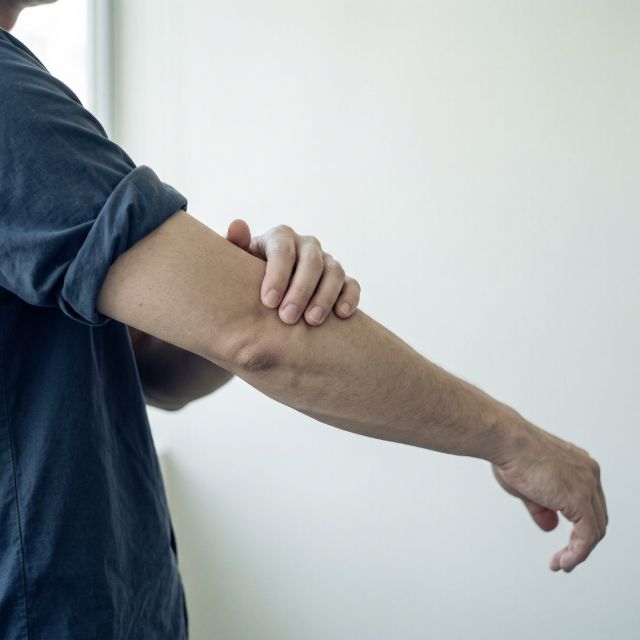
Pain and tenderness on the outside of the elbow.
We’re closed right now. WhatsApp us and we’ll reply when we open.
- Registered Chiropractor 註冊脊醫
- Doctor of Chiropractic D’Youville College, USA
- Whampoa & Hung Hom Near Whampoa MTR
Tennis elbow (lateral epicondylitis) is pain on the outside of the elbow, where the tendon of the forearm muscles that lift the wrist attaches to the bone. It is usually caused by overloading this tendon through repeated gripping and wrist movements, and despite the name, most people who get it don’t play tennis. Most cases improve with non-surgical treatment, although recovery can take months; if pain follows a fall or injury, or comes with numbness or weakness in the hand, seek medical attention promptly.
Key points
- The classic symptom is pain on the outside of the elbow when you grip, lift or twist, such as turning a door handle or lifting a kettle.
- Numbness or tingling in the hand, or pain spreading from the neck down the arm, suggests the problem may not be only in the elbow.
- Treatment depends on severity and how long you have had it: from changing how you grip and lift, strengthening exercises and hands-on care, to injection or, rarely, surgery.
- Severe pain, swelling or deformity after a fall or injury, or an elbow you can’t bend or straighten, needs prompt medical attention.
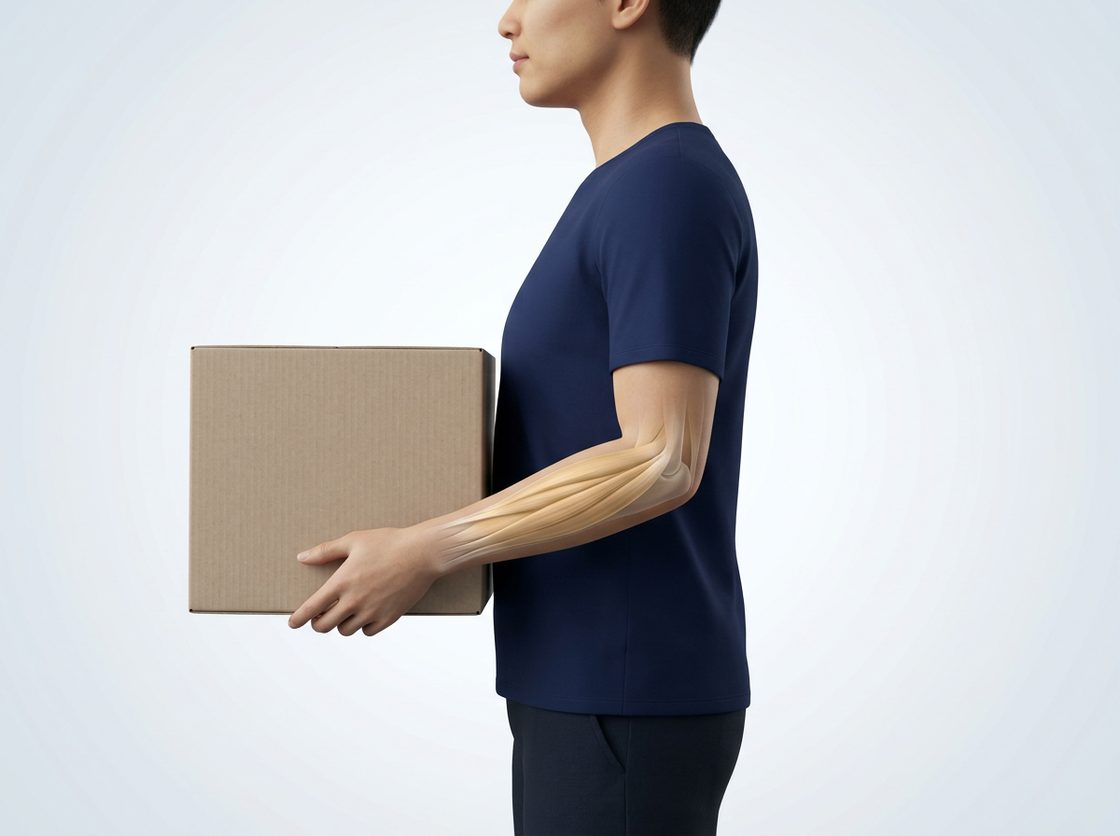
The muscles that lift the wrist and straighten the fingers run along the back of the forearm. Near the elbow, their tendons join into a common tendon that attaches to the bony bump on the outside of the elbow, called the lateral epicondyle.
Tennis elbow develops when this tendon is overloaded by repeated gripping and wrist movements, most often in the part belonging to a muscle called the extensor carpi radialis brevis. The tendon can’t keep up with repairs, and small areas of damage and wear build up. Despite the medical name “epicondylitis”, inflammation is usually not the main problem, which is why rest alone often doesn’t fix it.
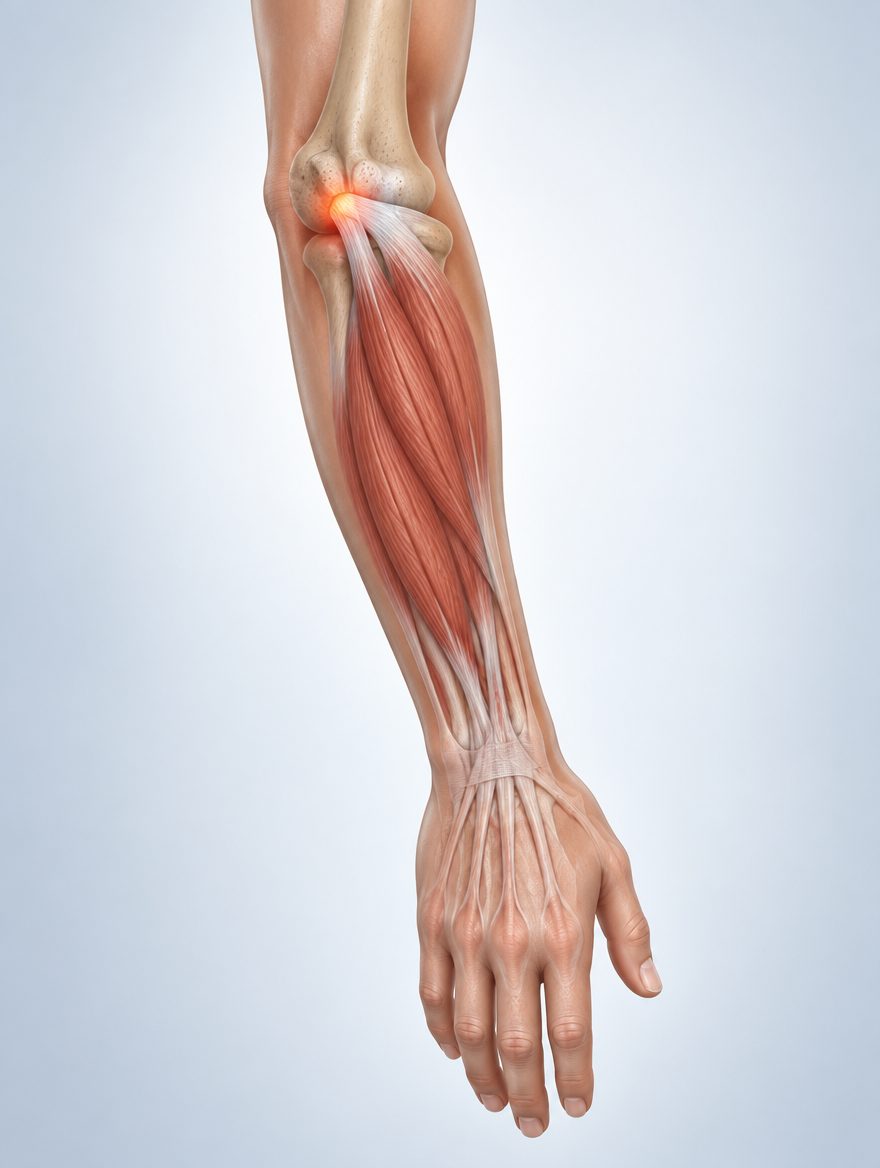
Pain usually builds up gradually over weeks or months, rather than starting with a single injury.
Common symptoms
- Pain or a burning feeling on the outside of the elbow, which may spread down the back of the forearm
- Pain when gripping, lifting or twisting, such as shaking hands, turning a door handle or opening a jar
- Tenderness when you press on or just below the bony bump on the outside of the elbow
- A weaker grip; holding a cup or lifting a kettle can be painful
- Stiffness or aching in the elbow or forearm, often worse in the morning
How it progresses
It usually progresses in these stages:
- EarlyPain comes on after activity, such as a long day at the computer or a game of tennis, and settles with rest.
- MiddlePain also comes on during activity, and everyday tasks such as lifting a kettle or wringing out a towel hurt.
- LatePain is there even at rest or at night, grip is clearly weaker, and it may be hard to hold a cup steady.
Symptoms don’t always follow this order. Many cases settle within a year, but some last up to two years, and the pain can come back.
Tennis elbow usually develops when the forearm does more than the tendon is used to, often over weeks or months.
- Repeated or forceful gripping and wrist movements, such as long hours using a mouse, carrying shopping bags, wringing out cloths or cooking with a heavy wok
- Manual work with tools such as screwdrivers, hammers or paintbrushes
- Racquet sports such as tennis and badminton, especially with poor backhand technique or the wrong grip size
- A sudden increase in work or training, such as moving house or taking up a new sport
- Smoking and being overweight
It is most common in people aged 30 to 50. Despite the name, only a small minority of cases are linked to tennis.
These two simple tests can give a first indication, but they cannot confirm a diagnosis. Stop if either test causes sharp pain.
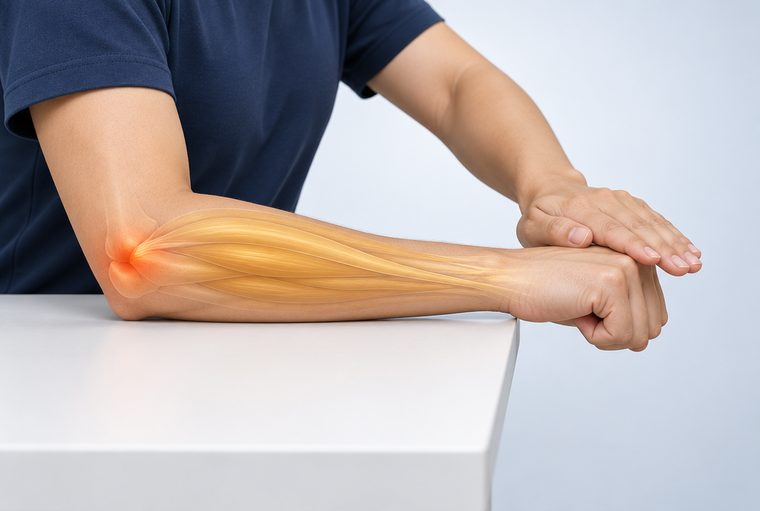
Resisted wrist extension test (Cozen’s test)
Rest your forearm on a table, palm down, with your hand over the edge, and make a fist. Try to lift your fist upwards while your other hand presses down on the back of it, so the wrist can’t move. Pain on the outside of the elbow is a positive result.
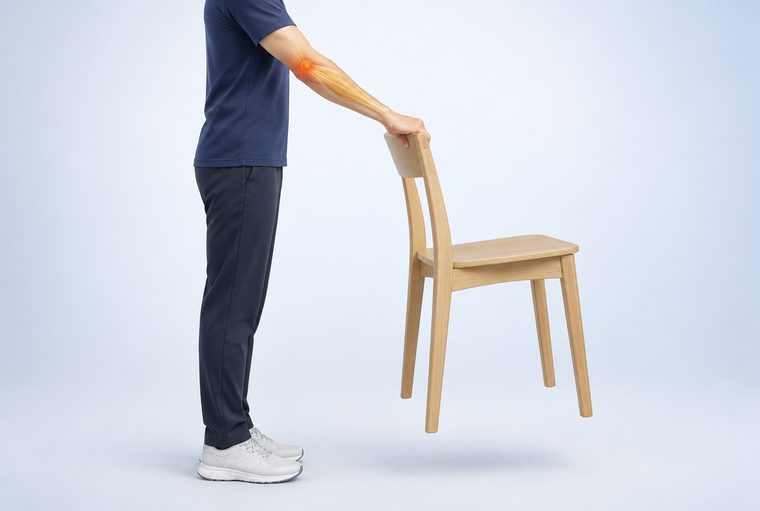
Chair lift test
Stand behind a light chair. With your elbow straight and your palm facing down, grip the top of the chair back and try to lift it slightly. Pain on the outside of the elbow is a positive result.
A positive result does not mean you have tennis elbow, and a negative one doesn’t rule it out. If pain keeps coming back, or affects your work or sleep, have it properly assessed by a healthcare professional.
Pain on the outside of the elbow has several possible causes. Finding where the pain is coming from is the key to choosing the right treatment.
Tennis elbow (the forearm tendon at the outer elbow)
- Where it usually hurts
- On or just below the bony bump on the outside of the elbow; can spread down the forearm
- Other clues
- Worse when gripping or lifting with the palm facing down; usually no numbness
A trapped nerve in the neck
- Where it usually hurts
- The outer elbow and forearm, as part of pain that travels down from the neck or shoulder
- Other clues
- Neck stiffness; pain may change when you move your neck; may come with numbness or tingling in the hand
Radial tunnel syndrome (a nerve squeezed in the forearm)
- Where it usually hurts
- The upper forearm, a few finger-widths below the outer elbow
- Other clues
- A deep ache, usually without numbness; easily mistaken for tennis elbow, and the two can occur together
Elbow joint problems (such as arthritis)
- Where it usually hurts
- Inside the elbow joint, around its outer side
- Other clues
- Stiffness, swelling, clicking or locking, or being unable to fully straighten the elbow
Neck problems and tennis elbow can also occur together: some studies have found neck problems are more common in people with tennis elbow, and treating the elbow alone may not be enough. That is why Dr. Ho assesses the neck, shoulder, elbow and wrist together.
Further reading: Neck pain, Herniated disc.
Diagnosis relies mainly on your history and a physical examination. Scans are usually not needed.
Your history: Where and when the pain appears, and your work, sport and hand-use habits.
Physical examination: Pressing over the tendon, testing the wrist and fingers against resistance, measuring pain-free grip strength and checking how the elbow moves. The neck, shoulder and wrist are also checked to rule out other causes.
Further tests: If the diagnosis is unclear, or pain doesn’t improve with treatment, Dr. Ho may suggest imaging such as ultrasound or an MRI scan, refer you for a nerve conduction study if a nerve may be involved, or refer you to an orthopaedic doctor.
Most people improve with non-surgical treatment. Treatment usually aims to settle the pain first, then gradually rebuild the tendon’s strength; surgery is rarely needed.
Non-surgical treatment
- Changing how you use your arm: Reducing the activities that provoke pain rather than resting the arm completely, changing how you grip and lift, and taking regular breaks.
- Progressive strengthening exercises: Exercises that gradually load the forearm muscles and tendon, done under guidance. Exercise is widely recommended as a core part of treatment.
- Elbow strap (counterforce brace): A strap worn on the forearm just below the elbow may ease pain during gripping for some people. Straps are generally available from pharmacies or sports shops.
- Hands-on and soft tissue treatment: Releasing tight tissues in the forearm and mobilising the elbow, which may help ease pain and improve grip in the short term.
- Shockwave therapy: Some studies suggest shockwave therapy may help cases that have lasted several months, although results vary.
- Ultrasound therapy: The research evidence is limited; it is generally used only as a supporting treatment.
Treatment prescribed by a doctor
- Medication or injections: Painkillers or anti-inflammatory medication may ease pain in the short term. A steroid injection may ease pain for a few weeks, but research has found the pain is more likely to come back later, so it is not usually the first choice. The evidence for other injections, such as platelet-rich plasma (PRP), is still mixed.
Surgery
- Tennis elbow release: The damaged part of the tendon is removed or released, through open, keyhole (arthroscopic) or needle-based (percutaneous) surgery. Surgery is generally considered only for severe pain that persists after 6 to 12 months of non-surgical treatment.

Dr. Ho first finds what is causing your elbow pain, then plans treatment based on the findings. General information only — your plan is set after an in-person assessment.
- 01
Assess
Examining the elbow, wrist, grip strength, shoulder and neck to tell whether pain comes from the tendon at the elbow or from elsewhere, such as the neck.
- 02
Treat
Hands-on and soft tissue treatment for the forearm and elbow (including the Graston Technique), combined with shockwave or ultrasound therapy where needed. If the neck is involved, it is treated as well.
- 03
Exercise and habits
A progressive strengthening programme for the forearm, with advice on gripping and lifting, your workstation set-up and sport technique.
- 04
Refer
If the diagnosis is unclear, pain doesn’t improve, or an injection or surgery may need to be considered, you will be referred for imaging or to an orthopaedic doctor.
Small changes to how you grip and lift can help reduce the load on the tendon, at work and at home.
- Lift with your palm facing up and your elbow bent and close to your body, rather than with your palm facing down and your arm straight.
- Use both hands for heavy things such as a kettle, a wok or shopping bags, and split heavy loads into smaller ones.
- Choose tools with thicker, padded handles, and don’t grip harder than you need to.
- Use a mop with a built-in wringer instead of wringing out cloths by hand, and a jar opener for tight lids.
- At the computer, keep the mouse close to your body and your wrist straight, rest your forearm on the desk, and take a short break every 30 to 60 minutes.
- For racquet sports, warm up first, check your grip size and backhand technique with a coach, and build up training gradually.
- When the elbow is sore, cut back on the activities that provoke it rather than stopping all use, then build back up gradually.
When to seek medical attention promptly
Seek medical attention promptly if any of the following apply:
- Severe pain, swelling or deformity after a fall or injury to the elbow
- Being unable to bend or straighten the elbow
- A hot, red, swollen elbow, especially with a fever
- Numbness, tingling or weakness spreading into the hand
- Neck pain with arm weakness
Many cases settle within a year, but some take up to two years, and the pain often comes back if the causes aren’t addressed. An assessment and a suitable exercise programme may help you recover sooner, especially if the pain is affecting your work or sleep.
Usually not. Most cases improve with exercise and other non-surgical treatment. A steroid injection may ease pain in the short term, but the pain is more likely to come back later. Surgery is generally considered only if severe pain persists after 6 to 12 months of non-surgical treatment.
Tennis elbow causes pain on the outside of the elbow, where the muscles that lift the wrist attach. Golfer’s elbow causes pain on the inside of the elbow, where the muscles that bend the wrist attach. Both are usually caused by overuse, and you don’t have to play tennis or golf to get them.
A strap worn just below the elbow may ease pain during gripping for some people, but it doesn’t treat the cause on its own. It is best used alongside exercise and changes to how you use your arm.
It depends on how severe your symptoms are, how long you have had them, and whether the neck is involved. Dr. Ho will discuss an expected treatment plan with you after your first examination.
That depends on your policy terms. Cover for outpatient care, injections, surgery and chiropractic treatment varies between policies, so check with your insurer before your visit. We are happy to provide receipts to support your claim.
Disclaimer
This page is general information only, not a diagnosis or treatment advice. If you have any symptoms, please consult a qualified healthcare professional.
Book a consultation with Dr. Ho, or message us on WhatsApp with any questions first.